
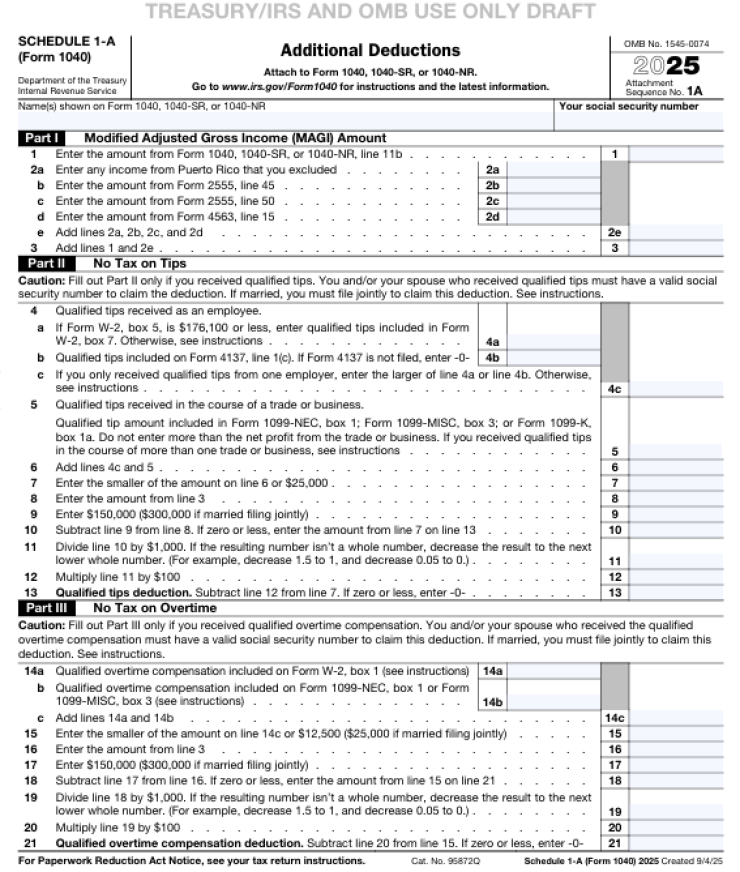
Tax season 2026 is officially underway – the IRS opened filing on January 26, and millions are already rushing to claim bigger refunds thanks to the One Big Beautiful Bill (signed July 4, 2025, as Public Law 119-21). At the heart of this relief? A brand-new form: Schedule 1-A (Form 1040), “Additional Deductions.”
This single page lets eligible taxpayers subtract four powerful new deductions directly from their adjusted gross income (AGI), lowering taxable income and potentially boosting refunds by hundreds or thousands. Best part? These are “below-the-line” deductions – you can claim them even if you take the standard deduction, and they don’t mess with AGI-based credits like the Earned Income Tax Credit.
But here’s the catch: These perks are temporary (2025–2028 only), phase out at higher incomes, and come with strict rules. Miss one detail, and you could leave money on the table – or trigger an audit. Let’s break it down so you can maximize yours this year.
What Is Schedule 1-A and Why Does It Matter Now?
Introduced specifically for the 2025 tax year (filed in 2026), Schedule 1-A consolidates four deductions from the One Big Beautiful Bill into one easy-to-use form. Attach it to your Form 1040, 1040-SR, or 1040-NR. The total flows to line 13b on your main return, reducing taxable income on line 15.
Key perks:
• No need to itemize on Schedule A.
• SSN required for tips/overtime (joint filing if married).
• MAGI (modified AGI) phase-outs limit benefits for higher earners.
• IRS expects big uptake – especially among service workers, hourly employees, new car buyers, and seniors.
With filing open and the April 15, 2026 deadline looming, understanding Schedule 1-A could be your biggest money move of the year.
The Four Game-Changing Deductions on Schedule 1-A
1. No Tax on Tips (Part II)
Up to $25,000 of qualified tip income becomes deductible (exempt from federal income tax, though payroll taxes may still apply).
• Qualifies: Voluntary tips in customarily tipped occupations (waitstaff, bartenders, drivers – check IRS Tipped Occupation Codes).
• Caps & Phase-Outs: $25,000 max; phases out above $150K MAGI (single) or $300K (joint).
• Pro Tip: Gather W-2s, 1099s, or logs – self-employed limit to net business income. Thought-provoking: Could this finally make tipped work more rewarding, or just shift the tax burden elsewhere?
2. No Tax on Overtime (Part III)
Deduct qualified overtime pay (time-and-a-half beyond standard hours).
• Caps: $12,500 (single) or $25,000 (joint).
• Phase-Out: Same as tips.
• Reality Check: Employers aren’t required to separate overtime on W-2s yet, so use pay stubs. If you worked extra in 2025, this could mean serious cash back – but only if you file jointly when married.
3. No Tax on Car Loan Interest (Part IV)
Deduct up to $10,000 in interest on loans for new U.S.-assembled vehicles (cars, trucks, vans, motorcycles).
• Qualifies: Loans after 2024, personal use only.
• Phase-Out: Starts at $100K (single) or $200K (joint) MAGI.
• Angle: Bought a new American-made ride in 2025? This could offset rising interest rates – but is it enough to boost auto sales long-term?
4. Enhanced Deduction for Seniors (Part V)
Flat $6,000 deduction if age 65+ by Dec 31, 2025 ($12,000 if both spouses qualify on joint return).
• Phase-Out: Above $75K (single) or $150K (joint) MAGI.
• Simple & Powerful: No extra paperwork beyond birth date – a nice boost for retirees on fixed incomes.
How to Fill Out Schedule 1-A (Quick Step-by-Step)
1. Part I (MAGI): Start here – add back certain exclusions to your AGI.
2. Parts II–V: Enter qualifying amounts, apply caps, calculate phase-outs using worksheets.
3. Part VI: Total everything and transfer to Form 1040, line 13b.
Use tax software (TurboTax, etc.) for auto-calculation, or download the form/instructions from IRS.gov. Keep records – audits love substantiation!
Potential Pitfalls & Pro Tips
• Joint filing required for tips/overtime if married.
• Phase-outs hit fast – run the numbers early.
• These are temporary – enjoy 2025–2028 while it lasts.
• Consult a pro if self-employed or complex income.
The Bigger Picture: Will These Deductions Deliver?
The One Big Beautiful Bill promises relief for working families, but critics question long-term deficits and fairness. Could bigger refunds fuel spending… or just mask inflation? What’s your take?
Call to Action
Which of these deductions applies to you? Have you already filed and seen a boost? Drop your story in the comments – let’s compare notes! Share this post if it helps someone claim more. Full IRS links in the resources below.
Resources
• IRS One Big Beautiful Bill Page
• Download Schedule 1-A & Instructions
• GetReady Tools at IRS.gov
File smart, claim big – happy tax season!

Leave a Reply