
The Earned Income Tax Credit (EITC), often called the EIC, is one of the most powerful anti-poverty tools in the U.S. tax code. It’s a refundable federal tax credit designed to help low- to moderate-income working individuals and families keep more of their earnings, reduce poverty, and encourage work. Unlike deductions that reduce taxable income, the EITC directly lowers your tax bill — and if the credit exceeds what you owe, the IRS sends you the difference as a refund.
This credit has lifted millions out of poverty each year, with the largest benefits going to families with children. In the current 2026 filing season (for 2025 tax year returns), many eligible taxpayers are claiming it alongside new perks from the One Big Beautiful Bill Act (like no tax on tips/overtime), potentially boosting refunds significantly.
How the EITC Works
The EITC is based on your earned income (wages, salaries, tips, self-employment income) and adjusted gross income (AGI) — the two must generally be similar for eligibility. The credit phases in as income rises (rewarding work), reaches a maximum, then phases out at higher incomes.
• It’s refundable, meaning you can get money back even if you owe no taxes.
• Investment income (dividends, interest, capital gains) must be limited — typically under about $11,950 for recent years (exact limit adjusts annually).
• You must have a valid Social Security Number (SSN) for yourself, your spouse (if filing jointly), and any qualifying children — ITINs don’t qualify.
• You must be a U.S. citizen or resident alien all year, have earned income, and not file as married filing separately.
• Age rules: Generally 25-64 if no qualifying children (with exceptions for former foster youth or homeless youth); no upper age limit if you have qualifying children.
The credit amount depends on:
• Number of qualifying children (under 19, or 24 if full-time student, or any age if permanently disabled; must live with you > half the year, etc.).
• Filing status (single/head of household vs. married filing jointly — joint filers get higher phaseout thresholds).
Current Amounts and Limits (for Tax Year 2025, Filed in 2026)
For the 2025 tax year (returns being filed now in 2026), here are the key figures:
• Maximum Credit Amounts:
• No qualifying children: $649
• 1 qualifying child: $4,328
• 2 qualifying children: $7,152
• 3 or more qualifying children: $8,046
• Income Limits (Phaseout Starts / Fully Phases Out):
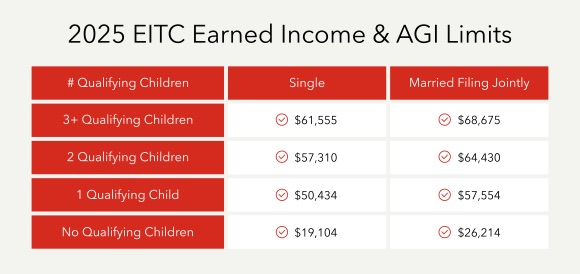
• No children: Starts ~$10,620–$19,104 (single/HOH) or ~$17,730–$26,214 (married joint)
• 1 child: Starts ~$23,350–$50,434 (single/HOH) or ~$30,470–$57,554 (joint)
• 2 children: Starts ~$23,350–$57,310 (single/HOH) or ~$30,470–$64,430 (joint)
• 3+ children: Starts ~$23,350–$61,555 (single/HOH) or ~$30,470–$68,675 (joint)
These are approximate based on IRS tables; use the official IRS EITC Assistant tool for exact qualification.
For tax year 2026 (filed in 2027), amounts are inflation-adjusted higher:
• Max credits: $664 (0 children), $4,427 (1), $7,316 (2), $8,231 (3+)
• Phaseout ranges shift upward slightly (e.g., 3+ children up to ~$62,974–$70,244 depending on status).
No major structural changes to the EITC from the One Big Beautiful Bill Act (which focused more on new deductions like no tax on tips/overtime/car loans, senior boosts, and Child Tax Credit increases to $2,200). But the EITC remains a strong complement — many tipped/overtime workers qualify for both, stacking benefits.
Why the EITC Is Thought-Provoking and Powerful
• It incentivizes work: The phase-in rewards earning more up to the max, then gently phases out.
• It fights poverty: Average credit for families with kids often exceeds $3,000–$4,000, directly reducing child poverty rates.
• Refund timing: EITC/ACTC refunds can’t be issued before mid-February (IRS rule to prevent fraud), so early filers claiming it wait longer.
• Common misses: Many eligible people don’t claim it (especially childless workers or those with modest self-employment income). If you’ve worked but haven’t filed, you might still qualify for a refund!
Quick Tips to Maximize and Claim It
• Use the IRS EITC Assistant (free online tool) to check eligibility.
• File even if below filing threshold — many get refunds only via EITC.
• Self-employed? Report all income; net earnings qualify.
• Double-check qualifying children rules (relationship, residency, age).
• Amend prior returns if you missed it (generally 3 years back).
The EITC isn’t just a “handout” — it’s earned through work and has broad bipartisan support for rewarding effort while supporting families.
Have you claimed the EITC before, or are you checking eligibility this season? What’s your biggest question about it — child rules, stacking with new deductions, or something else? Drop it below — let’s discuss! If you’re in Chicago or anywhere, local VITA/TCE sites offer free help for EITC claims. Tag a friend who might qualify! 💰 #TaxTips #EITC #FinancialFreedom #2026Taxes
(For blog: Expand this into a 1,500+ word post titled “Ultimate Guide to the Earned Income Tax Credit (EITC) in 2026: How to Claim Thousands in Refunds This Season” with sections, tables, examples, and SEO keywords like “EITC eligibility 2026,” “maximum EITC 2025,” “refundable tax credits,” etc.)
For X TTOTD: “TTOTD: The EITC could put up to $8,046 back in your pocket for 2025 if you have 3+ kids and income under ~$61K–$68K (depending on status). It’s refundable — work pays off literally! Filing now? Use IRS Assistant to check. Who’s claiming it? 👇 #TaxTip #EITC #MoneyMoves”
For LinkedIn: “With 2026 filing underway, don’t overlook the Earned Income Tax Credit (EITC) — a refundable powerhouse for working families. Max $8,046 for 3+ children in 2025 returns. It pairs well with new One Big Beautiful Bill perks like overtime deductions.
Who in your network qualifies but hasn’t claimed? Share tips or questions below — happy to point to IRS resources!
#TaxPlanning #EITC #PersonalFinance #WorkforceDevelopment #2026Taxes

Leave a Reply