
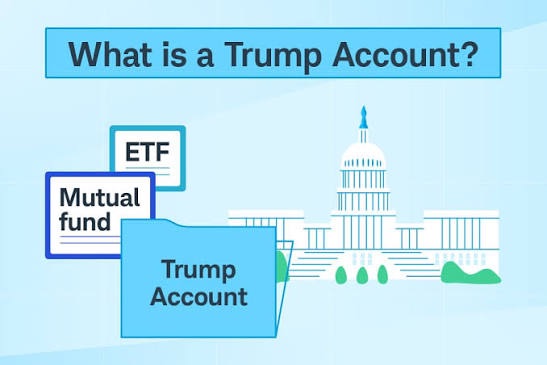
Trump Accounts are a new type of tax-advantaged savings and investment account introduced under the One Big Beautiful Bill Act (OBBBA), signed into law on July 4, 2025. These accounts, also referred to as Section 530A accounts, function like traditional individual retirement accounts (IRAs) but are designed specifically for children under age 18. They aim to provide long-term financial security through tax-deferred growth and limited government support for eligible newborns.
What Is a Trump Account?
A Trump Account is an IRA established for the exclusive benefit of an eligible child. It allows contributions to grow tax-deferred, with earnings not taxed until withdrawal. During the “growth period” (while the child is under 18), the account has restrictions on investments and distributions to promote long-term saving. After the child turns 18, it transitions to standard traditional IRA rules.
The program includes a pilot for a one-time $1,000 federal contribution (seed money) for qualifying children.
Eligibility Requirements
To establish a Trump Account:
• The child must be a U.S. citizen with a valid Social Security number (SSN).
• The child must be under age 18 at the end of the calendar year in which the election is made.
• There are no income limits for the family establishing the account.
• Each child can have only one Trump Account.
For the $1,000 pilot program contribution:
• The child must be born between January 1, 2025, and December 31, 2028.
• The child must be a qualifying child (as defined under IRC Section 152(c)) for the individual making the election.
Children born before 2025 or after 2028 can have accounts but are not eligible for the government seed.
Government and Other Contributions
• The federal government provides a one-time $1,000 pilot program contribution for eligible children (born 2025–2028) upon election approval.
• No contributions (including the seed) can be made before July 4, 2026.
• Annual contribution limit: Up to $5,000 total per child per year (subject to inflation adjustments after 2027).
• Sources include parents, guardians, family members, friends, employers (up to $2,500 per year excluded from the employee’s taxable income), and certain qualified general contributions (e.g., from nonprofits or governments, which may not count toward the limit).
• Contributions are not tax-deductible.
Tax Benefits
Trump Accounts offer tax-deferred growth: Earnings (interest, dividends, capital gains) are not taxed until withdrawn.
• During the growth period, distributions are generally prohibited except in limited cases (e.g., excess contributions, death, or certain rollovers).
• After age 18, withdrawals follow traditional IRA rules: Qualified distributions (e.g., for higher education, first-home purchase up to limits, or after age 59½) may avoid or reduce penalties; early non-qualified withdrawals may incur income tax plus a 10% penalty (with exceptions).
• Employer contributions up to $2,500 are excluded from the employee’s gross income.
How to Set Up a Trump Account
1. An authorized individual (typically a parent or guardian) makes an election using IRS Form 4547 (Trump Account Election(s)). This form is available in draft and can be filed with the 2025 federal tax return (filed in 2026) or at any time.
2. The form also allows election for the $1,000 pilot contribution if eligible.
3. Starting mid-2026, elections may be made online via trumpaccounts.gov.
4. After election, the Treasury Department (or agent) provides authentication details (expected starting May 2026) to open the account with a qualified custodian (e.g., bank or brokerage).
5. Contributions begin July 4, 2026.
Investment Options
During the growth period, investments are limited to low-cost (fees ≤ 0.1%) eligible funds tracking broad U.S. stock indexes (e.g., S&P 500). This promotes stability and accessibility.
Withdrawal Rules
• No general withdrawals before the year the child turns 18.
• After 18, standard IRA rules apply, including exceptions to the 10% early withdrawal penalty for qualified higher education expenses, first-time home purchases (up to certain limits), disability, or other IRS-approved purposes.
• At age 18, the child becomes the account owner and can direct investments and distributions.
Impact on Other Tax Benefits
Trump Accounts do not affect eligibility for other child-related credits like the Child Tax Credit. Withdrawals may influence financial aid calculations (similar to other retirement accounts). Consult IRS Publication 970 for education-related interactions.
Key Dates for 2026
• January 26, 2026: IRS begins accepting 2025 tax returns (including Form 4547).
• April 15, 2026: Standard filing deadline for 2025 returns.
• May 2026: Treasury begins sending authentication info.
• July 4, 2026: Earliest date for contributions and funding (including pilot seed).
Trump Accounts offer families a structured, tax-advantaged way to save for children’s futures, with government seed money for newborns born 2025–2028 and flexible contributions. For official details, visit IRS.gov, trumpaccounts.gov, or consult a tax professional. This program is part of broader 2026 tax changes under the One Big Beautiful Bill Act.

Leave a Reply